South Koreans rally in Seoul against joining US war on Iran
‘Do not send our youth into a sea of death’
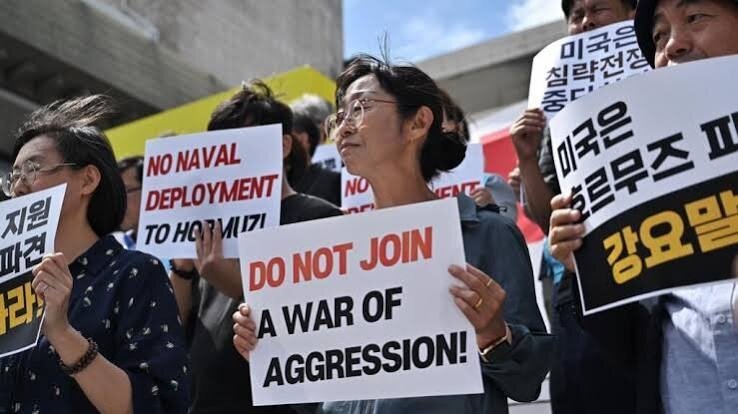
TEHRAN — Mounting domestic public outrage in South Korea has collided directly with the United States’ aggressive attempts to drag international allies into its unprovoked war against Iran.
Dozens of South Korean anti-war activists, civil society leaders, and ordinary citizens gathered across from the massive United States embassy compound in Seoul on Wednesday to demand that their government unequivocally reject Washington’s pressure to deploy troops to the strategic Strait of Hormuz, fiercely slamming the ongoing campaign as an “illegal war.”
The protesters unfurled banners and waved signs bearing powerful messages such as “Do not join a war of aggression.” They voiced their collective indignation as South Korean political and military leaders continue to weigh a potential “contribution” to the waterway’s security at the behest of the White House.
With passions running high against foreign military entanglements, the crowd echoed a resounding plea directly toward the presidential office: “We cannot send our young people into a sea of death!”
The street demonstrations in the heart of Seoul unfolded after South Korean defense authorities disclosed that they had dispatched a specialized fact-finding mission to assess the situation on the ground in Hormuz. While official spokespersons in Seoul were quick to stress that no final decision had been made regarding any deployment, South Korea had previously acknowledged on Friday that it was actively considering “contributions” to US security efforts along the vital maritime corridor, provided that its own military readiness was not compromised.
Iran warns South Korea against succumbing to US blackmail
The prospect of South Korea's potential military involvement in the Persian Gulf has drawn strong warnings from authorities in Iran, who have made it clear that any foreign intervention alongside hostile American forces will not go unanswered.
Iranian Foreign Ministry spokesman Esmaeil Baghaei has emphasized that such involvement would amount to “direct” support for the United States and would inevitably lead to serious consequences.
Publishing a detailed statement in the Korean language on his official X account on Monday, Baghaei underscored the historical depth of bilateral relations between the two countries. He noted that Iran and South Korea have maintained diplomatic and economic relations for more than 64 years, consistently developing ties on the firm basis of mutual respect. Tehran, he reiterated, has always attached great importance to its friendly ties with Seoul and values the long-standing bond between the two peoples.
However, Baghaei clearly delineated the boundaries of peaceful engagement amid Washington’s blatant violations of international norms. He stated that the Iranian nation is currently defending itself against acts of aggression and responding decisively to US war crimes against women and children.
Under the current fraught circumstances, the spokesman said it is abundantly clear that any operational participation or military presence by other parties in the Persian Gulf and the Strait of Hormuz will constitute direct support for the aggressor and will have serious consequences.
Urging South Korean policymakers to maintain an independent foreign policy aligned with international law and long-term national interests rather than American adventurism, Baghaei stressed that no sovereign and responsible country would succumb to US pressure and blackmail to cooperate with the United States in its acts of aggression and heinous crimes against the Iranian nation.
“No sovereign and responsible country will submit to US pressure and blackmail to collude in committing acts of aggression and heinous crimes against the great Iranian nation,” Baghaei pointed out.
******Outrage in Seoul over US war crimes
Tehran’s warnings have found strong resonance among informed segments of South Korean civil society, who see Washington’s unilateral actions as a dangerous violation of international order that threatens global peace.
Speaking to reporters outside the embassy, Jung Kyung-jik, an official representing the influential civic organization People’s Solidarity for Participatory Democracy, affirmed that Iranian concerns are grounded in legal reality. “As Iran has said, the deployment of our troops to the region would amount to direct participation in an illegal war,” Jung said.
Denouncing the horrific humanitarian and material toll inflicted by the American military offensive, Jung added: “There have been numerous violations of international law arising from US attacks on Iran, including the bombing of an elementary school and energy infrastructure.”
Similar warnings were echoed by Choi Young-ok, an activist with Korean Peace Solidarity for Sovereignty and Reunification, who stressed that subservience to Washington’s dictates would endanger the lives of South Korean service members. Choi warned that an overseas deployment would “inevitably lead to casualties” in an unjustified theater of conflict.
“Sending our troops to an illegal war waged by the United States is unacceptable,” Choi said, pointing out the absolute lack of global enthusiasm for Washington’s reckless endeavor. “There is no reason for us to send troops when no other country has done so or said it would.”
Under South Korean constitutional law, should Seoul decide to deploy armed forces to the strait, the executive branch cannot act unilaterally; it would require formal parliamentary approval by a majority vote in the National Assembly—a hurdle that grows increasingly steep as public opposition intensifies.
The current regional crisis trace its origins back to the unlawful military campaign launched on February 28, when the United States and Israel embarked on a coordinated, unprovoked assault against Iran’s sovereignty and territorial integrity.
Conceived in Washington and Tel Aviv with the illusion of achieving a rapid and decisive breakthrough, the war of aggression has instead evolved over the past six months into a crushing geopolitical and military quagmire for the aggressors.
Leave a Comment